Money habits lock in by age 7. School starts teaching money at 17.

Networthy closes the gap. Hands-on financial literacy for kids in grades K-5, with short digital missions they run on their own and real-money challenges they run at your kitchen table.

The free lesson needs no signup, no card, and no email. Just tap and play.

Teaching in a classroom? Networthy is built for elementary classrooms too: every lesson pairs digital instruction with printable activities, assessments, and a lesson-by-lesson standards crosswalk, so teachers can teach state-required financial literacy with virtually no prep. See the teacher setup

Your kid will manage money for the next 80 years.

School will spend 13 years teaching them how to earn it. Math class will teach them how to count it. Then, one lesson short of the whole point, the curriculum stops.

Nobody teaches them what to do with the money.

Skipping this lesson has a price.
Here's the receipt.

4 in 5parents wish they had learned more about money as kidsSource: OnePoll for Chase
74%of teens say they don't feel confident or knowledgeable about personal financeSource: Greenlight survey, 2021
1 in 3teens can't tell a credit card from a debit cardSource: Greenlight survey, 2021
82%of parents are actively looking for resources to teach their kids good money habitsSource: OnePoll for Chase
$3,100average credit card debt carried by a college studentSource: Annuity.org
1 in 3American adults has delayed a major life decision because of moneySource: AICPA / Harris Poll, 2018

None of these people failed math. They were never taught the subject underneath the math: what to do with a dollar. And notice the first number: it isn't about kids at all. Four in five PARENTS wish someone had taught them. If nobody taught you either, that's not your failure. It's a cycle. This is where it stops.

The research

Researchers found the window. It opens at 5 and starts closing at 7.

Cambridge University researchers found the money habits kids carry into adulthood take shape by age seven. Patience. Planning. Delayed gratification, the learnable skill of waiting for something better. The instinct to save before spending.Source: Whitebread & Bingham, University of Cambridge, for the UK Money Advice Service (2013, PDF)

The Consumer Financial Protection Bureau goes further: kids are ready to learn saving at age five, and kids who grow up with a savings account hold more savings and more assets as young adults. Source: CFPB, "Why childhood is an important time to learn about money"

One more finding matters most. The CFPB found an allowance alone builds nothing. An allowance plus guidance builds the habit. Source: CFPB, allowance research findings

Networthy is the guidance, packaged so you don't have to invent it.

What schools teach

A few states are catching on. Most haven't.

Texas tucks financial literacy standards inside K-8 math class, a few minutes at a time.

Source: Mathematics TEKS, Texas Education Agency. The financial literacy strand is 5.10, listed in full just below.

New York went further. In March 2026, the Board of Regents made personal finance instruction mandatory for every public school student, kindergarten through 12th grade. Elementary schools must teach it by the end of grade 4, starting with the 2027-28 school year.

Source: New York State Education Department: Personal Finance Education instructional requirement

Most other states still teach nothing about money until high school, a decade after the habits form.

Networthy is built to the standards anyway: full coverage of the Texas elementary financial literacy strand and the national personal finance standards, named and listed below. If your state catches up, your kid is ahead. If it doesn't, your kid is covered.

The standards, by name. "Standards-aligned" is easy to say; here's exactly what we're built to, so you can check.

2021 National Standards for Personal Financial Education

Published jointly by the Council for Economic Education and the Jump$tart Coalition for Personal Financial Literacy, the national standards define six topics every financially literate student should master:

Earning IncomeSpendingSaving InvestingManaging CreditManaging Risk

Networthy is built to the Grade 4 benchmarks across all six topics. Why Grade 4 for a grade 5 course? The national standards only set benchmarks at grades 4, 8, and 12, and each one describes what a student should know by the END of that grade. Almost no kid is actually taught the Grade 4 material on time, so grade 5 is where it gets taught properly, mastered, and stretched.

And in one place we go well past the band: budgeting is a Grade 8 benchmark nationally. Networthy teaches it at grade 5, three years early, because waiting helps no one.

Read the full standards (PDF, Council for Economic Education) · Jump$tart Coalition: National Standards

Texas TEKS: Math 5.10, every strand

Texas writes personal financial literacy directly into elementary math. The Grade 5 course covers all six strands, lesson by lesson:

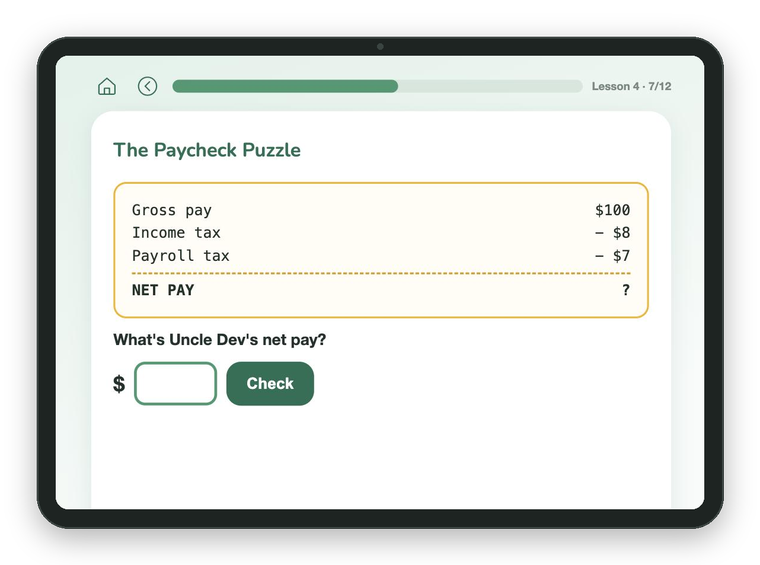
  • 5.10A Define income tax, payroll tax, sales tax, and property tax (Lesson 4)
  • 5.10B Explain the difference between gross income and net income (Lesson 4)
  • 5.10C Advantages and disadvantages of checks, credit cards, debit cards, and electronic payments (Lesson 6)
  • 5.10D Develop a system for keeping and using financial records (Lesson 10)
  • 5.10E Describe actions to balance a budget when expenses exceed income (Lesson 10)
  • 5.10F Balance a simple budget (Lesson 9)

Mathematics TEKS, Texas Education Agency · full standard text: 19 Texas Administrative Code, Chapter 111, Section 111.7 (Grade 5)

New York, and whoever's next

New York is the first state to require personal finance instruction by grade 4, starting in the 2027-28 school year. The New York crosswalk is done: every one of NYSED's 14 elementary learning objectives mapped to a specific lesson, plus 19 of the 23 middle-band objectives advanced in grade 5. Every family and classroom gets it with the course, ready to hand to a principal, a co-op, or a state program.

New York State Education Department: Personal Finance Education requirement

Built for ESA programs: Texas TEFA, Arizona ESA, and New Hampshire EFA (vendor listings in progress)

Proof you can watch

You won't need a report card. You'll see it at the grocery store.

Most courses ask you to trust a certificate. This one produces behavior you can watch for, on a schedule:

How it works

Ten minutes on screen. Then out into the real world.

The pace: 16 lessons. Two a week is one semester. One a week is a school year. It's fully self-paced, nothing expires, and there's no subscription clock ticking behind your family.

1

Your kid drives.

Short interactive missions built for independent work. Stories, games, and puzzles starring kids with real money problems, like a $7 hole in a $24 budget. No lectures. No worksheets pretending to be fun.

2

The money gets real.

Every unit ends offline: a real budget built on their real allowance, a savings goal with their name on it, a signed Money Plan on the fridge. The course finale is a working mini business with an actual profit report.

3

You get the highlights.

A 60-second note after each lesson plus one dinner-table question. Your total weekly commitment is two minutes. When their budget breaks in week three, you'll know exactly what to ask instead of what to fix.

What's inside

The Grade 5 course

By lesson 16, your kid has built a budget, rescued a broken one, kept four weeks of money records, dodged three kinds of scams, and run a business with a profit report to show for it.

Then they can teach it back to you. That's the test.

The difference

Most money programs for kids get one thing wrong. All of it stays pretend.

Cartoon coins. Quizzes about vocabulary words. Games where kids earn virtual dollars to spend on virtual avatars, and nothing is ever at stake.

Kids see through pretend.

Networthy runs on a different rule: every dollar in the course needs a job, and the dollars are real. The budget is their actual allowance. The savings goal is their skateboard. The business at the end earns real profit, theirs to keep, split across save, spend, and share.

When a virtual budget breaks, a kid shrugs and restarts the level. When their real budget breaks in week three, they learn something they keep for life.

Real money means real autonomy: their dollars, their calls, their consequences, at an age when a mistake costs $4 instead of $4,000.

Game money teaches vocabulary. Real money teaches habits.

From the very first family

"I had a front-row seat while the very first kid went through these lessons: my grandson. Two weeks in, we were at the grocery store and he gave me a whole lecture at the shelf about how the big box was not actually the better deal, with the math to prove it. Commercials get called out by name now. 'That's the clock trick, Grandma.'

When a ten year old starts explaining opportunity cost at Sunday dinner, something in these lessons is working."

Stacy Hagar

Grandmother of Networthy's first student

For teachers

One block a week. Zero prep. Standards documented to the code.

Why Networthy fits your classroom

  Zero teacher prep

  Fits one 45-minute block

  Aligned to TEKS 5.10, the 2021 National Standards, and NYSED learning objectives

  Pre/post assessments included

  No student accounts, no data, no IT review

  Family engagement built in

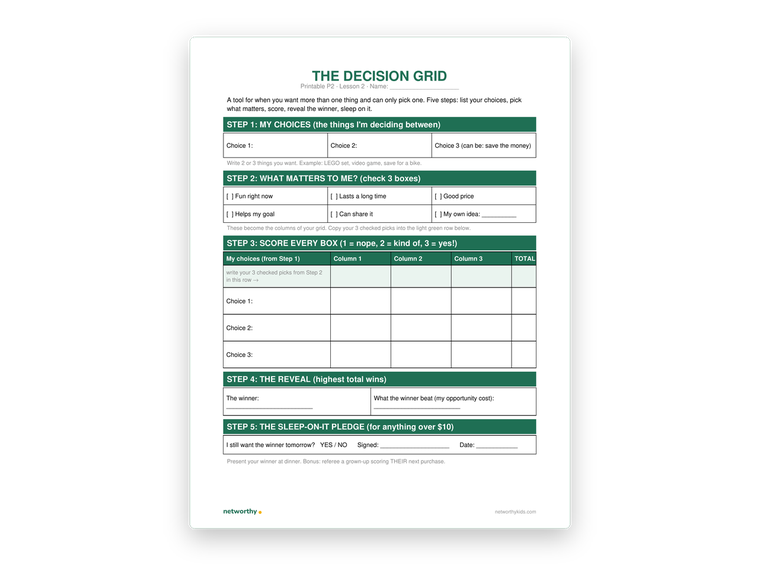
  Printable classroom activities

  16 interactive lessons, any browser

If anyone knows the money-education gap is real, it's you. You're not the reason it exists; you're how it closes.

You have 45 minutes and no time to build anything. Here's the block: kids run the 12-15 minute digital lesson self-paced (any browser, nothing to install), then the printable becomes the activity. Several are already group-native: Budget Rescue is a card game, the Payment Match-Up runs in pairs.

Pacing that fits real calendars. One lesson a week fills a semester. Two a week fits a nine-week grading period. The finale is a class market day with real profit reports.

No logins. No student accounts. No data collected. There is nothing for your IT department to review, because we hold nothing. Progress saves on each device.

Homework that respects households. Family missions go home as optional engagement, never graded work, and every one has an in-school alternate (the payment tally moves to the cafeteria line). We don't grade kids on their households.

Evidence for your admin. A 20-question pre/post assessment, per-unit rubrics with answer keys, and a lesson-by-lesson crosswalk mapping every lesson to TEKS 5.10 and the 2021 National Standards, ready to hand to your principal.

Teaching in New York? The personal finance mandate for grades 5-8 begins THIS school year, 2026-27, with K-4 following in 2027-28. Our New York crosswalk maps every NYSED elementary objective (14 of 14) and the middle-band objectives a grade 5 classroom can reach (19 of 23) to specific lessons, built against the March 2026 published objectives. Email us and it's yours.

And no, it's not $79 a student. The price below is family pricing. Classroom and school licensing is priced separately, and sensibly: email us for school pricing.

Tell us your grade and state. A person replies, usually the founder.

A note from the founder

I'm a mom of three. I've spent over five years working in EdTech, and like a lot of parents, I supplement what school teaches at our own kitchen table.

Here's the belief that started Networthy: a financial education is one of the best gifts you can give a kid. Better than money itself. Money gets spent. Skills and knowledge compound for the rest of their life.

And here's what bothers me. Some kids get that gift automatically. In families with wealth, kids learn about money at the dinner table, because there's money to manage and parents who make sure the lessons happen. Kids from families where money is never talked about get the other inheritance: they learn what interest means from their first credit card statement, and what debt means from their student loans. That gap is not about talent. It's about access. It's an unfair advantage handed out at birth, and it's fixable for the price of one video game.

I built this course with my 10-year-old son, the first and toughest student it ever had. He vetoes anything boring, confusing, or fake, and his edits ship the same week he makes them. Every lesson your kid takes has already survived mine.

Jordan Velazquez

Founder, Networthy

One price. Whole household.
No subscription.

Grade 5 Complete Course
$79

Every lesson, every printable, every badge, for every kid in your house.

Get the Grade 5 course

The first two lessons are free. If the full course doesn't earn its keep in 30 days, your money comes back, no questions asked.

Already have a family access code? The button above is your door.

Paying with ESA or school-choice funds? See the ESA question in the FAQ below.

Questions parents ask

How much of my time, as the parent, does this take?

Two minutes a week. Kids drive the lessons independently. You sign one Money Plan, honor it, and ask the dinner questions we send you.

My kid has no allowance. Does this work?

Yes. The Earn It First path has kids launch a small service (dog walking, car washing, helping a neighbor) and budget their first earned dollars instead.

How much screen time is involved?

Ten to fifteen minutes per lesson, twice a week. The rest happens at the kitchen table, the store, and the neighborhood. This is the rare course where the screen sends kids away from it.

What devices does it work on?

Anything with a web browser: tablet, laptop, desktop, or phone. Nothing to install, no app store, no accounts, no passwords. A tablet is the sweet spot for most kids, and you'll need an internet connection while playing.

Two practical notes: progress saves on the device itself, so have your kid use the same one each time. And the missions use printable sheets, so a home printer helps (a library or print shop works too).

What ages does this fit? What about other grades?

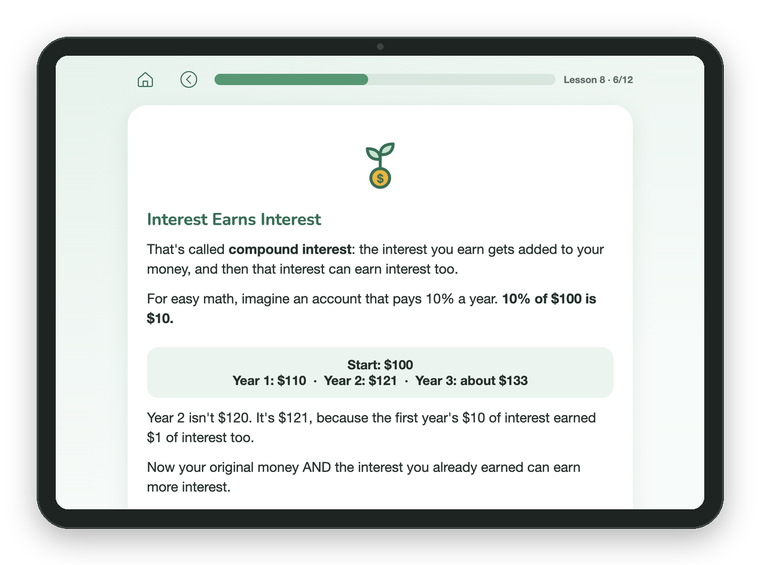
This course is built for grade 5, ages 9 to 11, and strong 4th graders do fine. And it's the start, not the whole story: we're building the full K-5 arc, and we started at the top on purpose. Grade 5 carries the hardest concepts in the arc, the ones we most need kids to truly grasp: budgets, interest, credit. And fifth graders are the toughest audience in it: old enough to run every real-money mission, and quick to call out anything boring, confusing, or fake. Perfect the system where the concepts are hardest and the critics are loudest, and it holds up all the way down, resized for each age.

The plan runs in order: dial in grade 5 with real families first, then build down grade by grade to kindergarten on the same system, then middle school so your kid never outgrows us mid-education, then high school. Our whole thesis is that money habits form early, so we'd rather perfect the foundation first.

Will this satisfy my state's requirements?

The course covers every strand of Texas TEKS 5.10 and maps to national elementary personal finance standards. Homeschoolers reporting to state programs get a standards crosswalk with the course.

Can I use ESA or school-choice funds to pay for this?

That's the plan. Networthy is a standards-aligned curriculum with assessments and a documented crosswalk, which is exactly what education savings account programs are built to fund. Our vendor applications for Texas TEFA, Arizona ESA, and New Hampshire EFA marketplaces are in progress now.

Until the listings go live: many ESA programs reimburse curriculum purchased directly, so buy the course, keep the receipt, and check your program's reimbursement rules. Not sure about your state's program? Email us at hello@networthykids.com and we'll look at it with you.

Is this ideological?

No. Networthy teaches mechanics and habits: earning, saving, spending with intention, giving, and staying out of bad debt. Your family supplies the values. We supply the reps.

Will my kid actually stick with it?

The course is built alongside real 5th graders who veto everything boring, babyish, or confusing, and their edits are in every lesson. Kids earn badges by doing, quizzes let them retry until they get it, and the missions involve real money, which kids take seriously because it's theirs. The review above is what sticking with it looks like.

Can't I just teach this myself?

You can, and this course makes you better at it. The sequence, the games, the printables, and the dinner questions are done for you; you supply the conversations, which were always the part only you could do. Most parents don't need more intentions. They need the system that makes the talks actually happen.

I'm a teacher. Can I use this with my class?

Yes. The lessons run self-paced in any browser with no logins and no student data, the printables work as group activities, and the standards crosswalk is written for your principal. See the For Teachers section above, and join the classroom pilot list.

Your kid will learn about money either way.

The only question is the tuition.

A $79 course at ten, with training wheels and small numbers. Or the usual route: interest rates explained by a first credit card, budgeting explained by an empty account, and lessons priced in real regret.

Small numbers now. Or big ones later.