The curriculum
Exactly what your kid will learn in all 16 lessons
16 interactive lessons across 8 units, designed for ages 8 to 12. Each lesson takes about 10-15 minutes on screen and ends offline, where your kid uses what they learned with real money and real choices. Every unit also includes a printable kit and a parent guide.
Kids take the 15-question Networthy Score before Lesson 1 and again after Lesson 16, so you can see what changed from beginning to end.
Standards shown against each lesson are the Texas TEKS 5.10 strands and the 2021 National Standards for Personal Financial Education. Crosswalks for Texas, New York, Utah, Iowa and Florida are free to download.
Unit 1: Money Choices · Lessons 1-2
L1: Needs, Wants & the One-Cart Rule. Scarcity and opportunity cost, then a real grocery run where every item in the cart needs a spoken why. National: Spending.
L2: How Smart Spenders Decide. A decision grid for real purchases, and the Sleep-On-It Rule. National: Spending, Saving.
Unit 2: Earning · Lessons 3-4
L3: Jobs, Skills & Paychecks. Where money comes from, and a priced Earning Menu with a first real customer ask. National: Earning Income.
L4: Gross vs. Net. Take-home pay, income and payroll tax on pretend pay stubs, then a sales tax hunt on a real receipt. TEKS 5.10A, 5.10B. National: Earning Income.
Unit 3: Spending · Lessons 5-6
L5: Ad Tricks & Unit Prices. Spot common techniques advertisers use to influence choices, then compare unit prices. National: Spending.
L6: Cash, Card, or Tap? Five ways to pay and whose money each one moves. TEKS 5.10C. National: Spending.
Unit 4: Saving · Lessons 7-8
L7: Goals Worth Saving For. The three things a savings goal needs, how to figure out the amount to save each month, and where to keep it. National: Saving.
L8: Where Money Grows. Why banks pay interest, compound growth, and the saving-vs-investing lanes. National: Saving, Investing.
Unit 5: Budgeting · Lessons 9-10
L9: Build Your First Budget. Build a money plan from the money they actually have coming in, give every dollar a job, then sign it and put it where they'll see it. TEKS 5.10F. National: Spending (a Grade 8 benchmark, introduced here).
L10: When the Numbers Don't Work. The three moves for a plan that stops working, and a 4-week money log. TEKS 5.10D, 5.10E.
Unit 6: Borrowing & Credit · Lessons 11-12
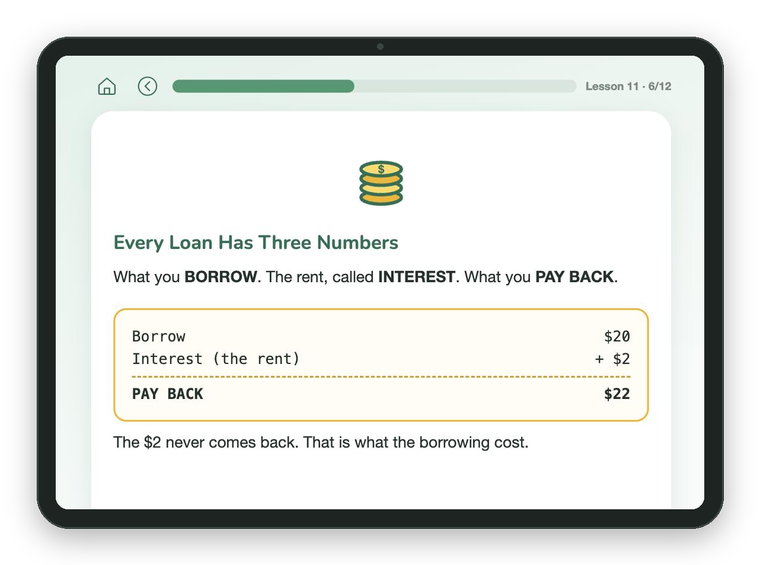
L11: What Borrowing Really Costs. Loans, interest as rent, and a real signed family loan with real payments. National: Managing Credit.
L12: Credit: Promise & Trouble. Credit as trust, the trust meter, and when borrowing helps vs. hurts. National: Managing Credit.
Unit 7: Sharing & Protecting · Lessons 13-14
L13: Giving That Counts. Planning giving around what your family cares about. National: Earning Income, Spending.
L14: Scam-Proof Yourself. Spotting scams, protecting information, and what insurance is for. National: Managing Risk.
Unit 8: The Capstone: My Money Enterprise · Lessons 15-16
L15: Plan the Business. A one-page business plan: costs, price, break-even, pitch. Applies everything.
L16: Launch, Count & Reflect. Run it for real, keep the records, calculate the profit, and decide what to do with the earnings. Applies everything.
What that adds up to
By Lesson 16, your kid has built a real money plan, adjusted it when the numbers didn't work, kept four weeks of money records, practiced spotting scams, and run a small business with a profit report to show for it.
The real test isn't whether they can repeat the vocabulary. It's whether they can explain the choices they made and use the skills outside the course.
A parent's email address opens the free lesson. No card.
Why grade 5 standards if the course is for ages 8 to 12?
Networthy aligns to grade 5 personal finance standards, and the learning experience is designed for kids ages 8 to 12.
Grade 5 is where many of the most useful elementary money concepts come together: taxes, budgeting, payment methods, saving and credit. Networthy teaches those ideas with small numbers, concrete situations and interactive practice, so kids can understand them before the stakes get high.
The frameworks we build to
"Standards-aligned" is easy to say. Here is exactly what Networthy is built to, so you can check it rather than take our word for it.
2021 National Standards for Personal Financial Education
Published jointly by the Council for Economic Education and the Jump$tart Coalition for Personal Financial Literacy, the national standards organize personal financial education into six topic areas:
Networthy is built to the Grade 4 benchmarks across all six topics. Why Grade 4 for a grade 5 course? The national standards set benchmarks at grades 4, 8, and 12, describing what students should know by the end of those grade bands. Networthy uses the Grade 4 benchmarks as foundational expectations and builds on them across grade 5.
In some areas the course also introduces concepts from later benchmarks. Creating a budget out of a given income is Grade 8 benchmark 8-1b, and Lesson 9 introduces it here.
Read the full standards (PDF, Council for Economic Education) · Jump$tart Coalition: National Standards
Texas TEKS: Math 5.10, every strand
Texas writes personal financial literacy directly into elementary math. The Grade 5 course covers all six strands, lesson by lesson:
- 5.10A Define income tax, payroll tax, sales tax, and property tax (Lesson 4)
- 5.10B Explain the difference between gross income and net income (Lesson 4)
- 5.10C Advantages and disadvantages of checks, credit cards, debit cards, and electronic payments (Lesson 6)
- 5.10D Develop a system for keeping and using financial records (Lesson 10)
- 5.10E Describe actions to balance a budget when expenses exceed income (Lesson 10)
- 5.10F Balance a simple budget (Lesson 9)
Mathematics TEKS, Texas Education Agency · full standard text: 19 Texas Administrative Code, Chapter 111, Section 111.7 (Grade 5)
Your state, specifically
Crosswalks mapping every lesson to the state framework exist for Texas, New York, Utah, Iowa and Florida, and are free to download.
For other states, Networthy's national standards alignment provides the broader framework.
One payment, every kid in your household, no subscription. 30-day money-back guarantee. No questions asked.